Showing posts with label scout. Show all posts
Showing posts with label scout. Show all posts
Monday, May 5, 2008

Thursday, April 24, 2008
1963 Scout + Toyota 2LT
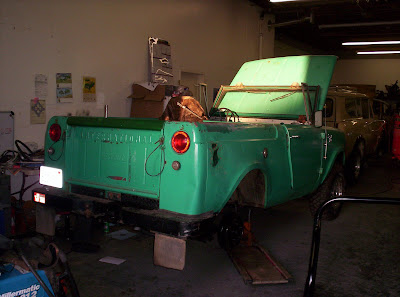
The guys at the shop are putting everything back together. Since I haven't actually driven it yet, all I can do is list off the new goodies and wait patiently. Planning a road trip next month, subjectivity forthcoming.
Toyota 2LT turbo diesel with 5-speed gearbox and transfer case (mechanical fuel pump); rebuilt Dana 44 rear, 4.27 gears and new drive shafts; new front disc brakes; new radiator, intercooler, and EGT gauge; new wiring harness; new shocks and springs; rebuilt Scout II bucket seats and roll bar (for 3pt seat belts!).
Rest assured this is still an International, despite the Australian-printed engine manual for the Toyota Hi-Lux and 4Runner diesels. It wouldn't be fun if there weren't projects left for me: having two (refinished) fuel tanks makes for straight-forward WVO conversion, and it's just crying for custom-welded bumpers. Stay tuned.
I'm selling the old 1963 Comanche 152 cu. in. engine.
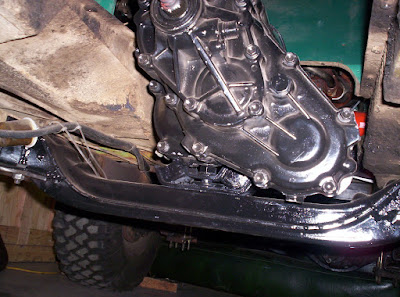
Toyota 2LT turbo diesel with 5-speed gearbox and transfer case (mechanical fuel pump); rebuilt Dana 44 rear, 4.27 gears and new drive shafts; new front disc brakes; new radiator, intercooler, and EGT gauge; new wiring harness; new shocks and springs; rebuilt Scout II bucket seats and roll bar (for 3pt seat belts!).
Rest assured this is still an International, despite the Australian-printed engine manual for the Toyota Hi-Lux and 4Runner diesels. It wouldn't be fun if there weren't projects left for me: having two (refinished) fuel tanks makes for straight-forward WVO conversion, and it's just crying for custom-welded bumpers. Stay tuned.
I'm selling the old 1963 Comanche 152 cu. in. engine.
Tuesday, July 17, 2007
Not no tiny little car gears
My uncle from LA said something along the lines of, "having a four wheel is added insurance for you, people who drive 4x4s are the kind of people who have guns."
I've got a 4x4 parked outside but the Dana 20 transfer case (the component which allows you to select between 2WD and 4WD low/high) doesn't work. Would-be perpetrators will want to watch out for me, even if I'm stuck in two-wheel drive. Keith from the scout shop said he even tried pushing on the lever with his legs.
That's the thing about the the scout, it's more like driving a tank than a passenger car. You can push levers as hard as you want. This is a three-speed/reverse unsynchronized manual transmission:
This means downshifting is difficult, but it doesn't bother me because when these gears grind it sounds like, "sorry, you have made an incorrect selection. please select a different gear." There are metal-on-metal sounds but it's BIG TOUGH metal gears refusing to mesh with BIG TOUGH metal gears at high RPM.
I know what you'll say, I should get a tractor.
I've got a 4x4 parked outside but the Dana 20 transfer case (the component which allows you to select between 2WD and 4WD low/high) doesn't work. Would-be perpetrators will want to watch out for me, even if I'm stuck in two-wheel drive. Keith from the scout shop said he even tried pushing on the lever with his legs.
That's the thing about the the scout, it's more like driving a tank than a passenger car. You can push levers as hard as you want. This is a three-speed/reverse unsynchronized manual transmission:
- The earliest automotive transmissions were entirely mechanical unsynchronized gearing systems. They could be shifted, with multiple gear ratios available to the operator, and even had reverse. However, the gears were engaged by sliding mechanisms or simple clutches, which required careful timing and throttle manipulation when shifting, so that the gears would be spinning at roughly the same speed when engaged; otherwise, the teeth would refuse to mesh.
When upshifting, the speed of the gear driven by the engine had to drop to match the speed of the next gear; as this happened naturally when the clutch was depressed or disengaged, it was just a matter of skill and experience to hear and feel when the gears managed to mesh. However, when downshifting, the gear driven by the engine had to be sped up to mesh with the output gear, requiring letting the clutch up (engagement) for the engine to speed up the gears. Double declutching, that is, shifting once to neutral to speed up the gears and again to the lower gear, is sometimes needed. In fact, such transmissions are often easier to shift without using the clutch at all. When using this method, the driver has to time the shift with relative precision to avoid grinding the gears. The clutch, in these cases, is only used for starting from a standstill. This procedure is common in racing vehicles and most production motorcycles.
Even though automotive transmissions are now almost universally synchronised, heavy trucks and machinery as well as dedicated racing transmissions are usually non-synchromesh transmissions, known colloquially as "crashboxes", for several reasons. The friction material, such as brass, in synchronizers is more prone to wear and breakage than gears, which are forged steel, and the simplicity of the mechanism improves reliability and reduces cost. In addition, the process of shifting a synchromesh transmission is slower than that of shifting a non-synchromesh transmission. For racing of production-based transmissions, sometimes half the teeth (or "dogs") on the synchros are removed to speed the shifting process, at the expense of greater wear.
This means downshifting is difficult, but it doesn't bother me because when these gears grind it sounds like, "sorry, you have made an incorrect selection. please select a different gear." There are metal-on-metal sounds but it's BIG TOUGH metal gears refusing to mesh with BIG TOUGH metal gears at high RPM.
I know what you'll say, I should get a tractor.
Sunday, July 1, 2007
1963 Int'l Scout 80
- 1963 International Harvester : Scout
1963 International Scout, 80, 4cyl all wheel drive
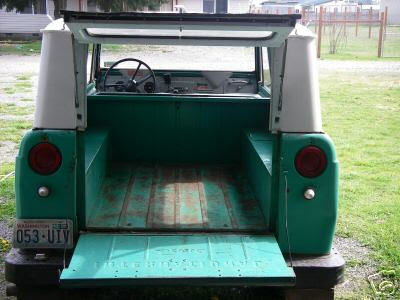
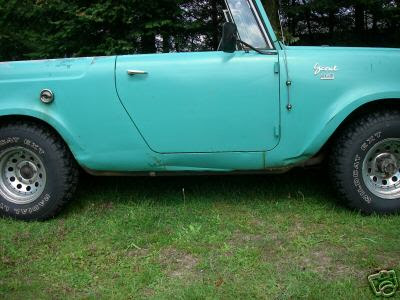
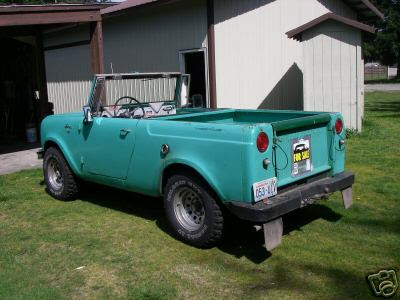
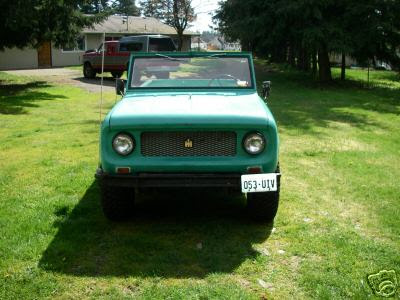
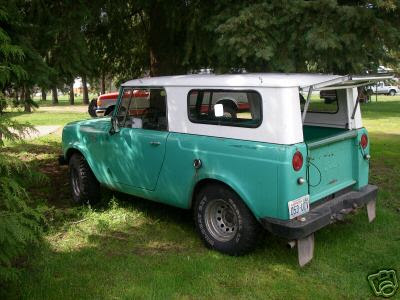
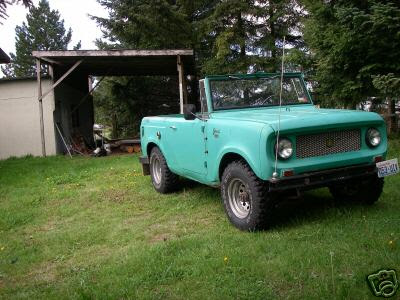
1963 International Scout 80. All wheel drive, removable hardtop, runs and drives great! new tires, fuel lines, electric switch between fuel tanks, clutch master cyl and slave cyl rebuilt, extra set of wheels and tires.
Used a couple of times a week as a spare veh. For a 63 she is in great shape, minor surface rust only, needs a paint job
put in the key pull out the choke and start her up. Take her top off and head down to the beach, or up to the mountains, she is at home in either place.
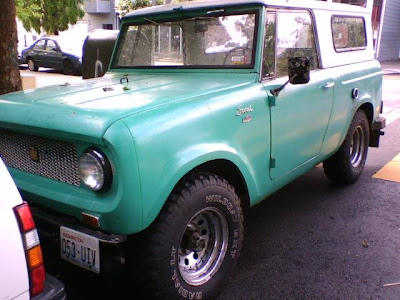
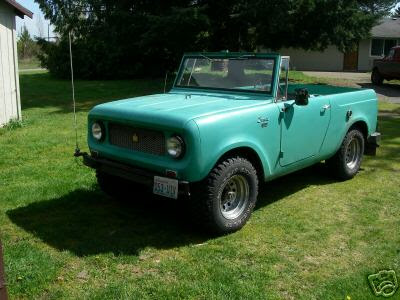
I won the bidding for $2,500 plus $650 for shipping from Rochester, WA.
This is a truck that drives like a tank (with roll-down windows and AM radio). 31 inch tires and bad-ass green paint. 85 horsepower gasoline engine and 3-speed manual transmission. People give me looks. The horn is awesome (best was Pete's description, "titty honking" along with two-handed squeeze gesture).
Top speed (freeway): 60mph
Top speed (hills): 5mph
I've driven about 150 miles, half of them with an ear-to-ear grin. It's a perfect beach cruiser, but it needs more power (and maybe an automatic transmission, satellite radio). I'm looking for a small, efficient turbo-diesel engine and a little restoration.
I made a few phone calls and found a new Scout shop in Redwood City, CA. Their chief mechanic named Keith somehow reminds me of Beavis (of Beavis and Butthead). His t-shirt reads "I'm the mechanic your mother warned you about" and he knows all there is to know about the IHC Scout.
It's in the shop now getting a 2.5" lift (new springs, bushings, and shackles) and Rancho 9000 RSX adjustable shocks.
(Anything else is just a car: this is not the first blog about a 1963 scout.)
Subscribe to:
Posts (Atom)
